From Zero to Infinity: The Philosophy of Numbers

From Zero to Infinity: The Philosophy of Numbers

Numbers from 0 to 3 form a fundamental structure—a code embedded in the very fabric of the universe. They shape the movement from emptiness to form, from potential to manifestation. Zero is eternity that has not yet made a choice. One is the first impulse, the birth of a vector. Two is the tension of opposites that creates harmony. Three is synthesis, a step beyond duality—the first complete system. Within this simple sequence lies the entire principle of how reality is formed, which later unfolds into more complex structures but always follows these primary foundations.

0 is not emptiness, but potential. Many perceive zero as absence, but everything is contained within it. It is the point before the birth of form, the state of stillness before movement. Zero does not mean “nothing”; it means “everything that has not yet manifested.” It is boundless because it can contain any beginning, any development, any transformation. That is why zero equals infinity—standing before a choice.

1 is the first impulse, the act of creation. Everything begins with the first step, the first choice, the first thought that breaks the silence of zero. One represents the awareness of oneself as a center, as a point of origin. It carries the meaning of individuality, the first boundary, the first “I.” It is the birth of movement, direction, and vector. If zero was potential, one is already action.
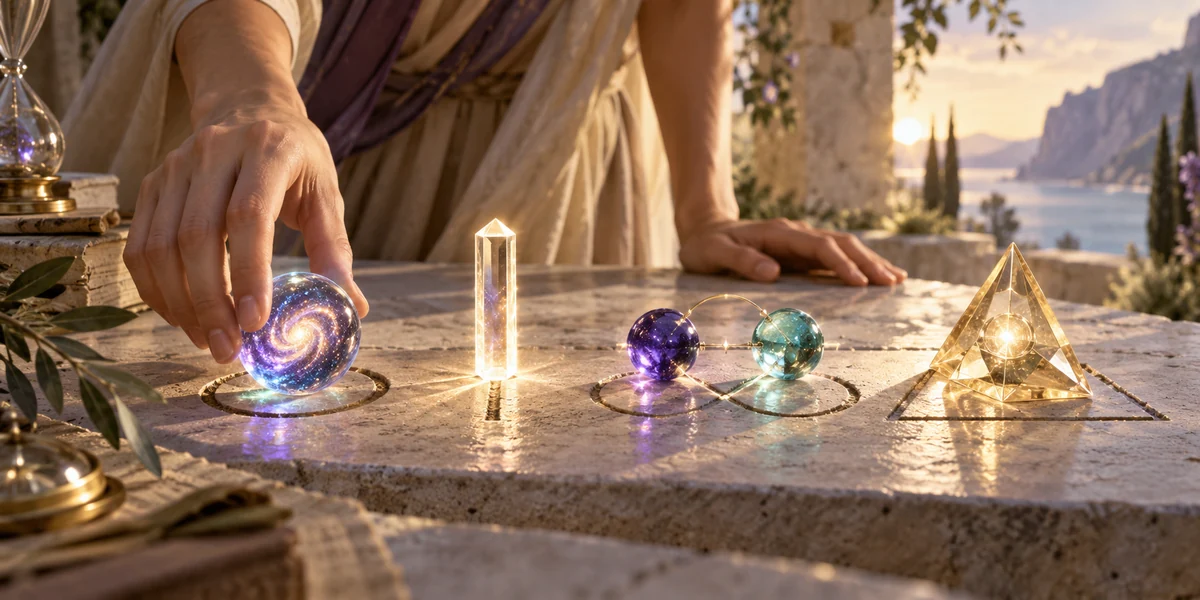
2 is the tension between opposites. With the appearance of the second comes interaction, dialogue. Two is rhythm, duality, balance—day and night, inhale and exhale, plus and minus. But not for separation—for connection. Through two, exchange begins, and harmony unfolds. Everything in the world moves not in isolation, but through the interaction of polarities.

3 is synthesis, a step beyond duality. When there are two, there is a choice: one or the other. But when a third appears, a new level emerges. Three unites, balances, and creates a new system. It is the triangle—the first stable form, the principle of “thesis—antithesis—synthesis.” Through three, wholeness manifests, because now there are not just two sides, but depth. 

From zero to three is the path from potential to creation. Each of these numbers is not just a symbol, but a stage in the formation of reality. We begin from emptiness, become aware of ourselves, enter into interaction, and ultimately create something new. This is the foundation of everything that develops, transforms, and evolves. Numbers are not just counting—they are the philosophy of movement from the unknown to the created.

Numbers shape the logic of existence. They appear everywhere—in the structure of the universe, in the rhythm of life, in every process. We ourselves move through this sequence again and again: we reset, define ourselves, interact, and synthesize. And so on endlessly, because every completed triad is only preparation for the next level.

Mathematics is the language through which the universe speaks about itself. And if we understand it not only through numbers but through meaning, we can see deeper than mere calculation. Zero, one, two, three are not just digits—they are the principles of movement of all that exists.
More in Time, Cycles and Cosmos

The Origin Beyond Time and Space
Time, Cycles and Cosmos

The Origin Beyond Time and Space

Whenever we ask what existed before everything began, we encounter a paradox that escapes ordinary logic. The Origin is not merely a moment in time—it is the very foundation of…

Read
Zero and Infinity: The Philosophy of Emptiness and Wholeness
Time, Cycles and Cosmos

Zero and Infinity: The Philosophy of Emptiness and Wholeness

Zero and infinity seem like opposites, yet they are two sides of the same unity. Zero symbolizes absence, a point of stillness where nothing has yet taken form. Infinity is…

Read
The Primordial Fire: The Boundary Between Being and Eternity
Time, Cycles and Cosmos

The Primordial Fire: The Boundary Between Being and Eternity

Fire is not simply an element; it is the fundamental force existing on the boundary between the material and the immaterial. It connects the visible and the invisible, creating a…

Read
A Trace in Eternity: What Will Remain After Us?
Time, Cycles and Cosmos

A Trace in Eternity: What Will Remain After Us?

Every one of us leaves a trace. The question is not whether it will remain, but what kind of trace it will be. We do more than simply live our…

Read
Every Day Is a New Chance to Create a New Reality
Time, Cycles and Cosmos

Every Day Is a New Chance to Create a New Reality

Every morning is a point of renewal—a moment when we choose whether to continue old patterns or create new ones. Your past does not have to become the boundary of…

Read
Two Leaps of One Day
Time, Cycles and Cosmos

Two Leaps of One Day

April 12 is a rare day when two celebrations do not compete with each other, but instead continue the same meaning. One is about inner resurrection, the other about flight…

Read
The Architecture of Time: How Consciousness Creates the Past and the Future
Time, Cycles and Cosmos

The Architecture of Time: How Consciousness Creates the Past and the Future

I understand more and more clearly that we do not leave the past behind — we reconstruct it again in every moment of the present. The past is not permanently…

Read
Cycles of Eternal Creation
Time, Cycles and Cosmos

Cycles of Eternal Creation

From the very moment we appear in the world, we are already part of a great triad. Father, mother, and child — three energies merging into one, forming the foundation…

Read
Light That Gives Birth to Worlds
Time, Cycles and Cosmos

Light That Gives Birth to Worlds

The Sun is an independent arbiter, an eternal witness, and a creator of reality. It does not judge or take sides, yet it is its energy that moves the world.…

Read
Numbers as Codes of the Universe: 4–9
Time, Cycles and Cosmos

Numbers as Codes of the Universe: 4–9

If the numbers from 0 to 3 represent the fundamental principles of the creation of reality, then the next level is the development of structure, its increasing complexity, movement toward…

Read
The Art of Time: Densifying Reality
Time, Cycles and Cosmos

The Art of Time: Densifying Reality

Time does not flow evenly; it obeys the focus of our attention. The more unfocused we are, the more often we become distracted, the faster it flies by, leaving behind…

Read
The power of the present moment: living here and now
Time, Cycles and Cosmos

The power of the present moment: living here and now

The phrase “don’t put it off until later” sounds familiar to almost everyone. But behind these words lies more than just advice. It’s a reminder that living in the present…

Read
Relevance — the art of being in harmony with time and self
Time, Cycles and Cosmos

Relevance — the art of being in harmony with time and self

To be relevant doesn’t mean adapting to the world, but being in dialogue with it. It’s not a game of trendy meanings or a desire to please, but an inner…

Read
Masters of time: the art of shaping reality
Time, Cycles and Cosmos

Masters of time: the art of shaping reality

Each of us is the master of our own time, although at times this sense slips away. Time is pliable: it compresses and stretches like breath. As soon as we…

Read
The hell of postponed happiness: why does the future overshadow the present?
Time, Cycles and Cosmos

The hell of postponed happiness: why does the future overshadow the present?

The person who sees the present only as a means to reach the future deprives themselves of life itself. When the present turns into an instrument, it loses its meaning…

Read
Looking back: the philosophy of time and the perception of the future
Time, Cycles and Cosmos

Looking back: the philosophy of time and the perception of the future

The perception of time is not just a habit but a fundamental way of interacting with reality. In some cultures, for example, among the Aymara people living in the Andes…

Read