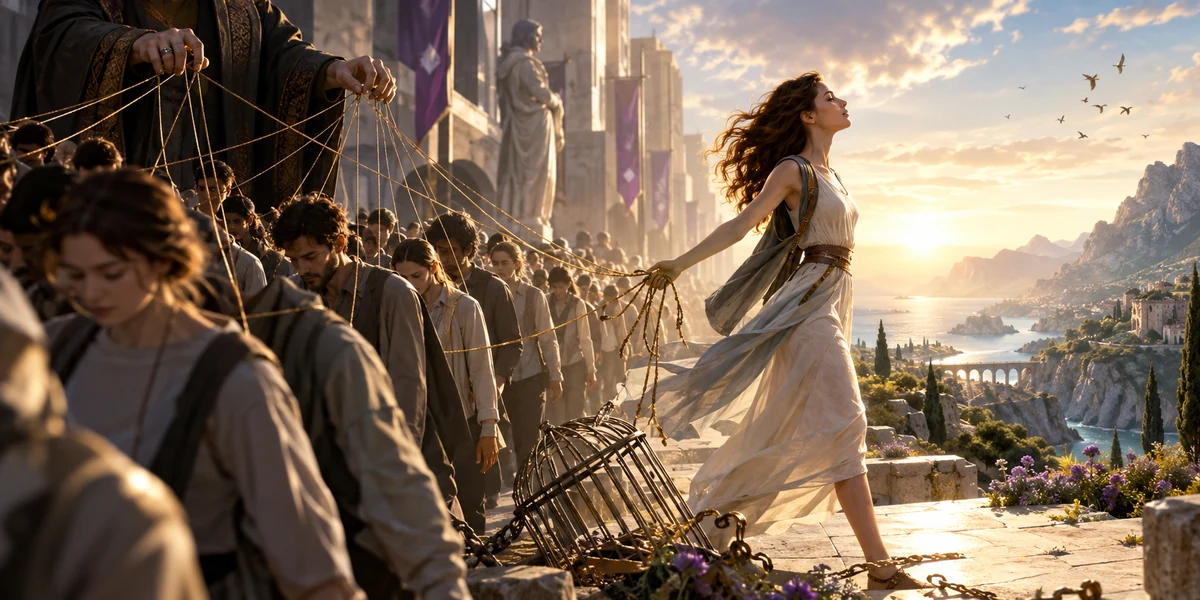

There are two seemingly opposite statements often heard when discussing personal responsibility. The first is: “I create my own reality and am fully responsible for it.” The second is: “The situation is the result of other people’s actions, and therefore it is their responsibility.” At first glance, these ideas seem contradictory. Yet on a deeper level, they are simply two different points of reference describing the same phenomenon.
The first perspective arises from a sense of wholeness. A person sees themselves as both a part of the world and the whole at the same time. There is no strict separation between “self” and reality; everything is interconnected, and each moment emerges through the interaction between the observer and potentiality. The observer and the observed become parts of a single process.
The second perspective places a person in a world of causes and effects. Events are viewed as the result of interactions between independent entities, and responsibility is distributed among participants. In this framework, there is a clear distinction between “self” and “others,” and a person tends to respond to reality rather than shape it.
Both perspectives are logical and can be true at the same time, depending on the chosen frame of reference. If we assume that an event exists as a set of possibilities before it is fixed, then attention and perspective determine which possibility becomes a fact. What changes is not the event itself, but the way it is perceived and interpreted.
The deeper a person becomes aware of their participation in events, the more power returns to the point of “I.” This is not about blame but about influence over one’s own state and choices. At the same time, the concept of shared responsibility reminds us that no one exists in isolation. Personal power and interconnectedness do not contradict each other—they complement one another.
An event is not only what happened; it is also how it is recorded by consciousness. By changing perspective, we gain access to a new version of experience. The point of reference becomes a portal: it can either limit perception or expand it. The more we allow for multiple interpretations, the closer we come to responsibility as a conscious co-creation of our reality.